Planning system
The numbers.
The gap by part, supplier site, plant, and week.
How big is the gap?
Supply-chain collaboration · Toyota × o9
A shortage. Many people. One room.
When a part runs short, fixing it scatters across teams, spreadsheets, and calls. I designed the shared room where Toyota and its suppliers work through it together.
Workflow design
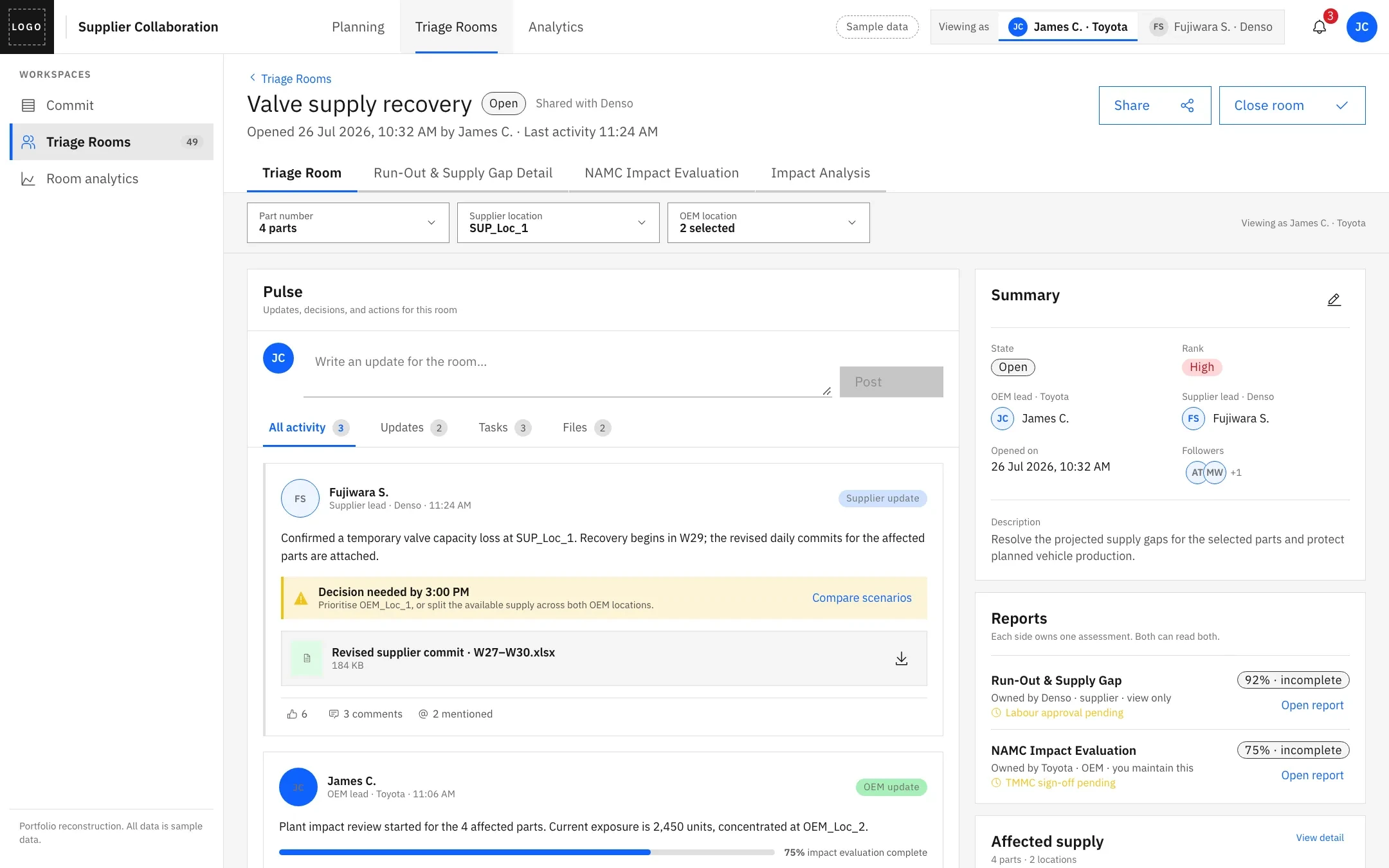
5 / 5Five questions, one place: 4 parts · SUP_Loc_1 · 2 OEM locations · both leads named · two owned reports · the pending decision and when it’s due.Prototype · sample data
Scattered · 01 / The problem
A planner could see the supply gap. Who was fixing it, what had changed and which decision was still waiting lived somewhere else.
Four places.
Five questions.
No shared record.
Planning system
The gap by part, supplier site, plant, and week.
How big is the gap?
Email & calls
What is constraining the supplier, and what recovery looks like.
Why is it happening?
Spreadsheets
Which plants and vehicles are exposed, and how soon.
What will it cost production?
People’s memory
Who agreed to what, on which call, and who acts next.
Who is doing what next?
| Question | Where the answer lived |
|---|---|
| 01What’s short, and where? | Planning systemThe gap by part, supplier site, plant and week. |
| 02Who is on it? | People’s memoryWho acts next, and who agreed on which call. |
| 03What do we know? | Email & callsSpreadsheetsThe supplier’s explanation in one place, the plant impact in another. |
| 04What’s been decided? | People’s memoryWho agreed to what, on which call. |
| 05What happens next? | People’s memoryWho is doing what next. |
The room had to answer all five without a search.Sources: the four fragments above
Scattered · 02 / The people
The supplier knows why supply is short, the planner knows what that means for production, and someone has to decide. Before the room, each kept their piece in a different place.
Supplier side
AsksWhen can we recover supply?
Buyer side · Toyota
AsksWhat does this mean for production?
Decides the response
AsksWhere do we need to step in?
Every shortage also brings
Two companies, commercially separateTime pressureMany parts × many plantsDecisions that need an ownerRoles from the requirements and the documented ownership model. They aren’t research personas, so there are no quotes or counts. Dashed rows are off the record; solid rows are on it.
UX lensA shared mental model
The problem wasn’t a lack of information. Each team held a different piece of it. The design had to make those pieces understandable together, while respecting the different decisions each side is responsible for.
Shared · 03 / The evidence
I read the requirements as one person’s task. Every shortage raises the same five questions, so the room had to answer each one in a fixed place.
What I worked from
What every shortage asked
Where the room answers it
What this evidence is
A requirements table, reviews with Toyota stakeholders on each direction, platform and engineering reviews, and a user validation session. My original design files show how the direction changed.
What it isn’t
A formal research study. There are no user quotes or counts here, and the five questions are my framing of the requirements, not a measurement.
Constraints
Shared · 04 / The approach
I translated the requirements into one journey of five moves. Each move adds to the same record instead of starting a new one.
The planner selects the shortage rows in the planning workspace.
Adds the scopeThe room opens with that scope and a lead from each side.
Adds the ownersEach side completes its own report, and reads the other’s.
Adds what each side knowsThe decision goes on the record, in the conversation.
Adds the decision and the next stepThe room closes and stays a readable record.
Keeps all five, read-onlyThe planner selects the shortage rows in the planning workspace.
The planner reached the supplier by email and calls.
The room opens with the scope and both leads.
Run-out & supply gap report
Plant impact report
Both sides read both reports.
The decision goes on the record.
The room closes and stays a readable record.
Each lane is who acts. The shortage enters from the OEM’s planning rows and stays in the shared lane until the room closes. Before the room, the same work ran between the two companies off the record.
Five principles, visible in each decision below
The goal wasn’t another chat tool.It was one shared account of the shortage.
Shared · 05 / Entry points
A planner spots the gap in the planning workspace and opens the room from those rows. Everyone else arrives through the room itself, with the scope and the owners already set.
AOEM planner
From the planning rowsSelects the shortage rows in the forecast and commit workspace, then creates the room there.
BBoth sides
From the rooms dashboardEvery room with its owners, rank, and state. A supplier sees only the rooms shared with it.
CBoth sides
Named as the room opensA lead and followers from each side. The supplier lead comes from that supplier’s own people.
This project
The Triage RoomWhen it closes
Watchlist
Part families stay watchedThe buyer chooses whether monitoring ends. A family stays monitored while a related room is still open.
A part number alone wasn’t enough: the same part can mean different things at different plants. A room holds one intersection or several. The room in the prototype holds four.
Sample dataShared · 06 / The turn
My first room looked organised: task counts, status cards, and a task grid. But a shortage doesn’t arrive as a tidy to-do list, so I moved the conversation to the centre and kept the structure beside it.
These are my designs, redrawn as low-fi in React with a neutral logo and sample names. Select a change to see where it moved. Click through all 15 screens
Task counts and a task grid took the main workspace. Work was visible, but the explanation behind it had nowhere to grow.
The Pulse conversation became the workspace. Updates, files, and decisions build one shared account of the shortage.
Posts, tasks, and attachments were separate views, switched from a toolbar.
Files, tags, and tasks travel inside each post, so evidence stays next to the discussion it supports.
The two reports sat behind buttons in the header, one step removed from the room.
Reports became tabs of the room: one step away, never somewhere else.
The summary: status, the two leads, report completeness, and the affected parts.
It stayed beside the conversation in both directions. It’s the stable reference while the thread moves.
Force / 01 · People
A shortage starts as a question, not an assignment. People need room to explain before they can divide the work.
Force / 02 · Platform
Pulse, forms, and grids already existed. Bespoke task widgets meant more to build, integrate, and support.
The decision
The tradeoff was deliberate: less task-management prominence, more space to coordinate. It changed the information architecture, not just the layout.
My original design files show the shift from task widgets to a Pulse feed, a persistent summary, and report tabs; the screens here are redrawn from them. The project records describe stakeholder reviews and platform feasibility discussions as the inputs.
Reuse was a design decision too. It let people bring what they already knew about the product into a new workflow, and it limited how freely every interaction could be customised. I accepted that where a familiar pattern supported the work, and used hierarchy to give the room its purpose.
Shared · 07 / Three decisions
Each decision puts more of the five answers on the record. The record beside each one shows what it added.
Decision / 01
A / BLANK FORM
A standalone create pageFlexibleB / OPEN CHAT
A general channelFast to startC / FROM THE ROWS
From the selected shortageContext arrives with the roomMore dots = better for the person opening the room. A design judgement, not a measurement.
I placed room creation beside the supply gap. Selecting the affected rows sets the part, supplier location, and plant before anyone starts explaining the problem. People check what’s already there instead of remembering identifiers and typing them again.
The tradeoff: a room is tied to a concrete supply issue. It’s less flexible than a general chat, and much clearer about what the conversation concerns.
Recognition over recall
Decision / 02
A / ONE SHARED DOC
Everyone edits everythingOpenB / SEPARATE ROOMS
A room for each sideClear ownershipC / OWNED REPORTS
Shared visibility, owned reportsBoth sides see bothConfidentiality depends on a second rule: a room is shared with one supplier organisation only.
A supplier knows why a part is running out. A buyer understands what that means for production. Sharing a room shouldn’t blur those responsibilities, so each side owns one report and can read the other’s.
The boundary: collaboration is scoped to the room’s participants. A common workspace must never imply access across suppliers.
Clear ownership
Decision / 03
A / ALL IN THE FEED
Everything is a postComplete historyB / ALL IN TABS
Everything is a pageTidyC / FEED + SUMMARY
Feed beside a steady summaryThe story movesA conversation explains how a decision happened. It doesn’t make the current situation easy to find. I kept ownership, status, report completeness, and affected supply beside the discussion, so everyone has a stable reference as the thread grows. The detailed reports wait one step away, in tabs.
Recognition over recall
Progressive disclosure
Before → decision → after
Start the room from the selected shortage rows.
Share the room, separate the reports.
Put the conversation beside a steady summary.
Settled · 08 / Follow the shortage
Everything above, in one run. Watch the prototype carry a single shortage through the five moves, then step through them one at a time.
Then take it one move at a time.
01 / Detect
A planner selects the affected part-location rows. The selection summary shows what the room will carry: one supplier, two OEM locations, and the projected gap.
The record
1 of 5: the selected rows set the scope, and the room opens with it.
4 parts · SUP_Loc_1 · 2 OEM locationsStart where the shortage is found
Open this step in the prototypeCreate a room from the shortage, switch between the Toyota and Denso views to see who can edit what, then close the room and watch it become a record. The data is sample data.
Settled · 09 / Beyond the happy path
The harder questions appeared at the edges. Each boundary below blocks something for a reason, and each keeps the planner’s work instead of throwing it away.
Boundary / 01 · Confidentiality
A selection that spans two supplier organisations can’t become one room. A shared shortage doesn’t make competitors one audience.
RecoveryKeep the selection and split it: “Keep Denso rows” or “Keep Aisin rows”.
Boundary / 02 · Continuity
A part and plant already in an open room shouldn’t start a competing conversation. The history and the ownership would split again.
RecoveryPoint to the existing room, or leave that row out and carry on.
Boundary / 03 · Lifecycle
Closing a room stops editing but keeps the record. Unfinished reports are called out first, and a related part stays monitored while another room is open.
RecoveryFinish or request the missing report, or close knowingly.
The recovery designs shown here are from the rebuilt prototype.
Review states,
not only screens.
UX lensError prevention & visible status
The open room looked finished long before its closed counterpart was. Defining what each state allows made the lifecycle coherent: a label, the available actions, and the explanation for unavailable ones all agree.
Settled · 10 / Outcome & reflection
What the project records support, what I don’t claim, and what I would test next.
Spot the gap
↓Email the supplier
↓Re-explain the parts
↓Assess impact in a spreadsheet
↓Reconcile on a call
↓Decide · who owns it?Select the affected rows
↓Open a room with context and leads
↓Each side completes its report
↓Discuss beside the summary
↓Agree on the next step
↓Close with a readable recordWhat changed
A room tied to the affected supply, not a blank conversation.
Visible leads on both sides and separate report responsibilities.
The discussion beside the current situation, not apart from it.
A closed room that stays a readable, trustworthy record.
What I can say
The original artifacts show a connected workflow and a substantive change of direction. The project records describe an initial Toyota launch, then enhancements and productization.
What I don’t claim
A measured drop in resolution time, feature adoption figures, or engineering savings. The prototype’s analytics are sample data, and they’re labelled that way.
Looking back
Platform feasibility pushed me to reconsider the room’s centre.
The room’s value depended on how context, authority, and lifecycle fit together.
Next, I’d test whether a returning participant can name the next action and its owner.
One room.
Five questions.
One shared record.
Chapter 01 started with four places and no shared record. Every shortage still raises the same five questions; now they’re answered in one room, and the answers stay readable after it closes.